Upright meaning
Examine whether your victory has eroded trust or damaged relationships. Winning at all costs often leaves you isolated despite the triumph.
 Tarovia
Card meanings
The Five of Swords can bring attention to tension, competing priorities, and the effects of how people handle disagreement. It is not a verdict on who is right. Read reflectively, it can help you notice what matters more than making a point, and what kind of exchange you are willing to take part in.
Keywords: Conflict · Compromise · Integrity
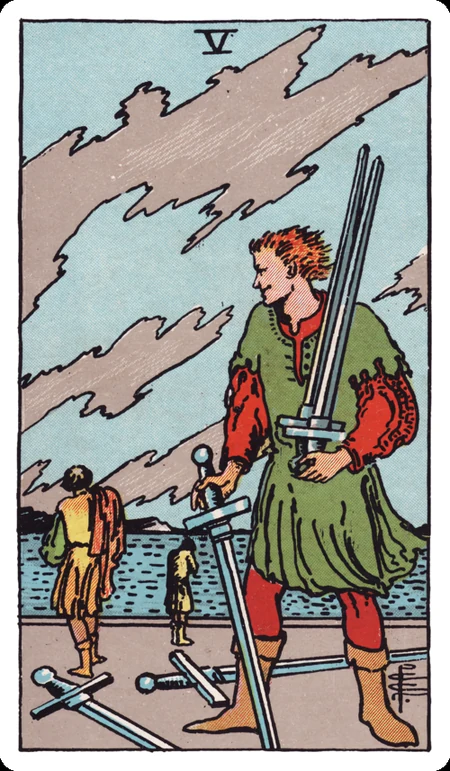
In the Rider–Waite–Smith illustration, a foreground figure holds three swords while two more lie on the ground. Two people walk away toward the water, and the sky is unsettled. The scene can invite reflection on what remains after a disagreement: who carries the consequences, what was gained, and whether the way a point was made still feels consistent with your values.
Examine whether your victory has eroded trust or damaged relationships. Winning at all costs often leaves you isolated despite the triumph.
Let go of the need to prove yourself right and seek reconciliation. Accepting defeat can be a powerful act of maturity and peace.
Notice whether the conversation is helping both people understand the issue or mainly keeping score. You might name the specific point you disagree on, listen for what matters underneath it, and agree to pause if either person feels unable to speak respectfully.
Separate the task at hand from the personal friction around it. Write down what needs to be resolved, what evidence or expectations are unclear, and who needs to be included. A clear summary can keep the next conversation focused and fair.
Before reopening a difficult exchange, consider what you can honestly own and what you still need to clarify. A brief apology, a boundary, or a request to talk later can be more useful than trying to settle every part of the disagreement at once.
Write down the issue, the value you want to protect, and one cost of continuing the argument as it is. Choose a small next step that addresses the issue without crossing that value.
Is this battle worth the cost of your own principles?
A. E. Waite’s 1911 description of Five of Swords
Tarovia’s interpretations are original reflective writing. This historical source is linked for context, not as a certain prediction.
Tarot is for reflection and entertainment. These interpretations do not predict a certain future or replace professional advice.