Upright meaning
Disagreements can serve to test ideas and clarify roles within a group. Engage with energy but keep your purpose clear.
 Tarovia
Card meanings
The Five of Wands can bring attention to lively differences, competing approaches, and the effort of finding common ground. It does not decide who is right or suggest that every disagreement is useful. Read it as a prompt to notice what is being contested, what outcome matters, and whether the way people are engaging supports that outcome.
Keywords: Conflict · Competition · Clarification
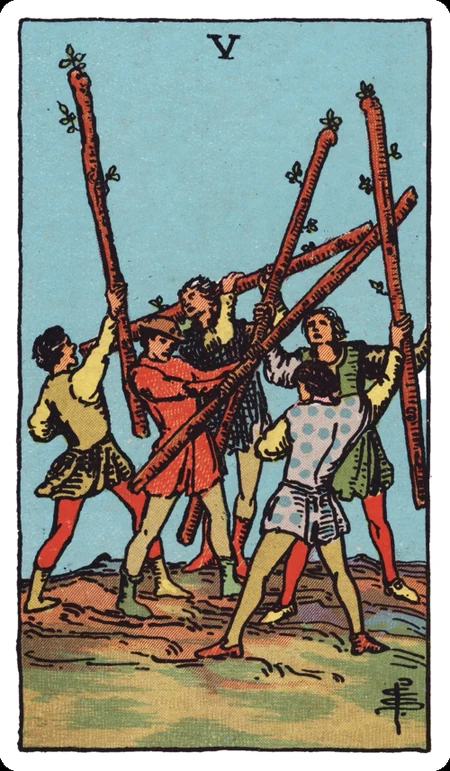
In the Rider–Waite–Smith image, five young men hold wooden staves aloft, their staffs crossing as they face one another. Their varied clothing and overlapping movements create a scene of apparent contest, without showing a clear victor. The image can invite you to look beyond the volume of a disagreement: identify the different positions, the shared task, and the rules that would let people engage without losing sight of why they gathered.
Disagreements can serve to test ideas and clarify roles within a group. Engage with energy but keep your purpose clear.
Conflict may arise without a constructive aim, draining your resources. Step back to distinguish between necessary friction and pointless struggle.
When a disagreement repeats, name the exact point where your accounts differ rather than debating character or intent. Each person can summarize the other’s view before responding. If that feels impossible, pause and agree on a time to return to the topic.
Make competing proposals visible: list them, compare them against the shared goal, and assign who will test or decide each part. This turns a loud exchange into a task with clear next steps and a review date.
If an argument keeps circling, notice whether anyone is learning new information or changing a position. Set a time limit, restate the decision at hand, and leave the discussion if it becomes personal; return only when there is a useful next step.
Write the disagreement in one sentence, then note the outcome you want and one question that could clarify the other position. Use that question in a calm, specific conversation, or save it for later.
Is this disagreement helping to refine my position, or is it merely noise?
A. E. Waite’s 1911 description of Five of Wands
Tarovia’s interpretations are original reflective writing. This historical source is linked for context, not as a certain prediction.
Tarot is for reflection and entertainment. These interpretations do not predict a certain future or replace professional advice.