Upright meaning
Notice where habits feel like chains, yet recognize that the links are often loose. Awareness reveals that choice and freedom remain available even in constraint.
 Tarovia
Card meanings
The Devil is often read as a card of attachment, temptation, and the parts of ourselves we would rather hide. It does not label you as bad or powerless. It can invite a closer look at what keeps drawing your attention, what it costs, and where a choice remains possible.
Keywords: Attachment · Shadow · Choice
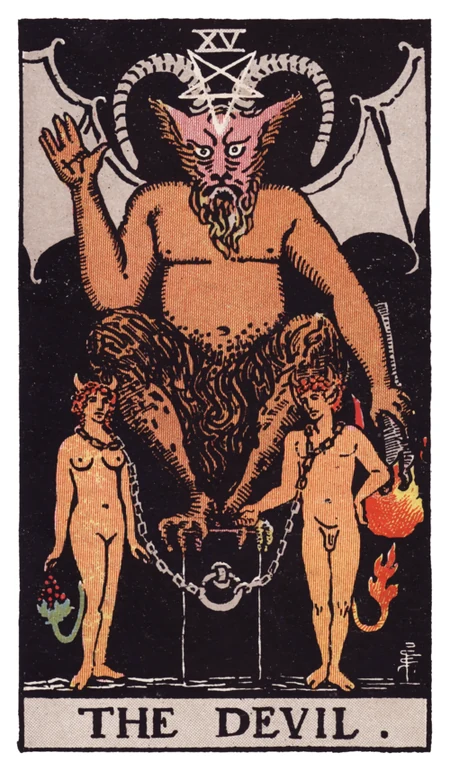
In the Rider–Waite–Smith image, a horned, winged figure sits above two nude figures. A reversed pentagram marks the figure’s forehead, one hand is raised, and the other holds a torch pointed downward. The figures wear collars connected by a chain. For reflection, notice how the scene pairs visible restriction with human agency; it need not define you or decide what you do next.
Notice where habits feel like chains, yet recognize that the links are often loose. Awareness reveals that choice and freedom remain available even in constraint.
Loosening a pattern requires facing shame or discomfort directly. Recognizing the chain is removable is the first step toward true liberation.
Use this card to examine your own boundaries and repeated exchanges, not to infer what the other person thinks. Note when you agree despite discomfort, what you are trying to avoid, and one clear request or limit you could communicate.
Choose a behavior that feels automatic, such as postponing a task or reaching for your phone. Track what happens just before it, what the habit gives you in the moment, and one small change to try next time.
Look at a situation you tend to keep private. Write down its observable consequences, the story you tell yourself about it, and one person or setting that could make an honest next step feel safer.
For one day, note a moment when you feel pulled into a familiar pattern. Record the trigger, your response, and one alternative you could choose next time. Treat the notes as information, not a verdict.
Which 'chain' in your life is actually a habit you can choose to release?
A. E. Waite’s 1911 description of The Devil
Tarovia’s interpretations are original reflective writing. This historical source is linked for context, not as a certain prediction.
Tarot is for reflection and entertainment. These interpretations do not predict a certain future or replace professional advice.