Upright meaning
Skill deepens through shared effort and honest dialogue with peers. Seek input early to ensure your work aligns with the collective vision.
 Tarovia
Card meanings
The Three of Pentacles is often read as a card of work made stronger through cooperation and practiced skill. It can invite you to value both your own contribution and the knowledge around you. Rather than promising approval or success, it offers a prompt to make expectations visible and let useful feedback shape the process.
Keywords: Collaboration · Craftsmanship · Constructive Feedback
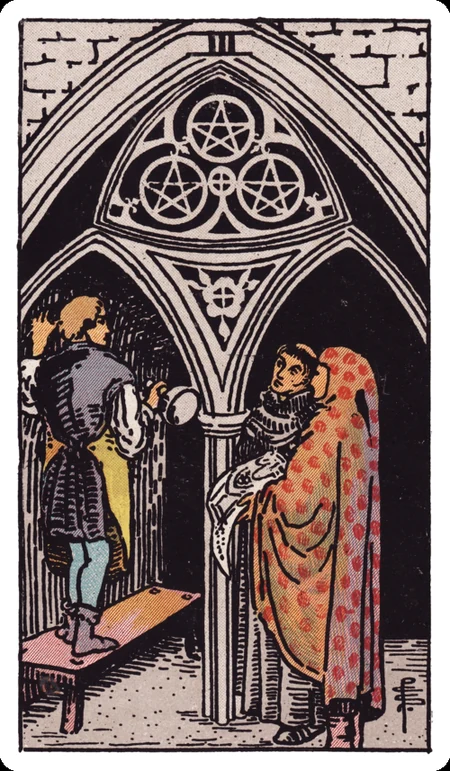
In the Rider–Waite–Smith image, a craft worker stands on a bench, shaping stone beneath an arch marked with three pentacles. Two other figures face the worker and consult a drawing. The scene can focus reflection on how individual skill meets shared standards: notice what each person contributes, what feedback is useful, and whether the finished work serves its purpose.
Skill deepens through shared effort and honest dialogue with peers. Seek input early to ensure your work aligns with the collective vision.
Unclear roles cause friction as individual efforts fail to integrate. Clarify expectations and communication channels to improve the outcome.
In a relationship, shared effort can be easier to recognize when care is expressed in specific actions. Notice which responsibilities each person carries, name one thing you appreciate, and discuss one task or expectation that would benefit from a clearer agreement.
At work or in study, ask for feedback while a draft, plan, or skill is still easy to adjust. Confirm what quality looks like, who needs to review it, and when. This keeps critique specific and gives you a clear way to apply it.
If a group project feels uneven, list the tasks and the person responsible for each one. Check how updates should be shared and what decisions need group input. This can reveal where expectations differ without assuming anyone is unwilling to contribute.
Choose one current piece of work. Write down its purpose, the standard it needs to meet, and one question for a trusted collaborator. Ask for feedback on that question, then decide what to keep or revise.
How can I better integrate my unique skills into the team's shared vision without losing my own voice?
A. E. Waite’s 1911 description of Three of Pentacles
Tarovia’s interpretations are original reflective writing. This historical source is linked for context, not as a certain prediction.
Tarot is for reflection and entertainment. These interpretations do not predict a certain future or replace professional advice.